
OVERVIEW
HGSI is a factory authorized TE Connectivity Macro Sensors distributor.
Have Pricing or Technical questions? Contact us today.
Complete the contact form, call us at 248-636-1515, or email us at sales@hgsind.com
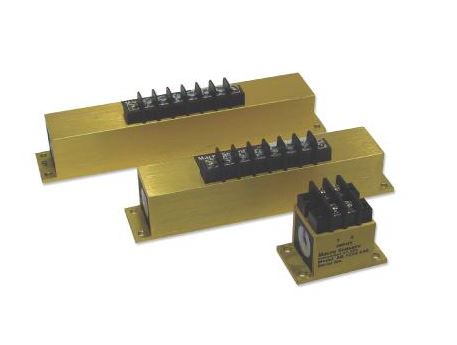
The TE Connectivity Macro Sensors SQ 1250 Series of heavy duty LVDTs were developed specifically to measure position or motion in mill-type hostile environments. These rugged and reliable contactless sensors, available in measuring ranges from ±0.50 inches to ±10.00 inches, have their electrical assembly totally encapsulated within a heavy duty aluminum housing, with their electrical connections made to screw-terminal style barrier strips. This complete encapsulation of SQ 1250 Series LVDTs allows them to withstand the high shock and vibration levels typically encountered in mill environments and permits them to meet the IEC IP-64 sealing standard against the intrusion of splashed water and other liquids.
SQ 1250 Series LVDTs are electrically and magnetically double shielded to maximize noise immunity and minimize their susceptibility to external AC magnetic fields developed by electric motors, transformers, etc. Because core shaft misalignment occurs often in mill applications, all SQ 1250 Series sensors incorporate Teflon™ bore liners to reduce friction and wear between the LVDT's core and its bore under such conditions, especially when measuring oscillatory motions.
SQ 1250 Series position sensors offer the high resolution, excellent repeatability, and low hysteresis associated with LVDT technology, as well as the highest sensitivity consistent with good linearity. The maximum linearity error for an SQ 1250 LVDT is ±0.25% of full range output, using a statistically best-fit straight line derived by the least squares method.
SQ 1250 Series LVDTs feature constant sum-of-the-secondaries output, so they can be used equally well with conventional differential input LVDT signal conditioners, or with ratiometric LVDT signal conditioners found in some industrial control systems.
Typical applications of SQ 1250 Series LVDTs are measuring roller gap position for hydraulic servo systems used to control primary metals rolling mills, sizing lumber to maximize yield in sawmills, maintaining proper calender roll position in paper mills, controlling steam valve opening in electric power plants, and measuring raker boom height in wastewater treatment plants.
Part Numbers
SQ-1250-500
SQ-1250-1000
SQ-1250-2000
SQ-1250-3000
SQ-1250-4000
SQ-1250-5000
SQ-1250-7500
SQ-1250-10000
Options:
TECHNICAL SPECIFICATIONS
DOCUMENTS & DOWNLOADS
VIDEOS
No Result Found
PRODUCT NUMBERS
TE Connectivity Macro Sensors Mill-Type Position Sensor for Hostile Environments
The SQ-1250 Series from TE Connectivity Macro Sensors represents the heavy-duty end of LVDT technology, specifically engineered for position measurement in mill-type hostile environments. Available in measuring ranges from ±0.50 inches to ±10.00 inches, these rugged AC-operated LVDTs feature complete electrical encapsulation within heavy-duty aluminum housings, double electromagnetic shielding, and Teflon™ bore liners for durability under conditions that would destroy lesser sensors. Harold G. Schaevitz Industries (HGSI) is a factory-authorized TE Connectivity Macro Sensors distributor.
LVDTs (Linear Variable Differential Transformers) are electromagnetic position sensors that convert mechanical displacement into a proportional electrical signal. Unlike resistive sensors that rely on sliding contacts, LVDTs operate through electromagnetic coupling between a movable core and stationary coil assembly. This contactless operating principle delivers exceptional resolution, repeatability, and reliability—critical attributes for the demanding measurement requirements of primary metals processing, lumber mills, paper mills, power generation, and wastewater treatment facilities.
The SQ-1250 Series achieves ±0.25% linearity using a statistically best-fit straight line derived by the least-squares method. The constant sum-of-the-secondaries output characteristic enables operation with either conventional differential-input signal conditioners or ratiometric signal conditioners found in some industrial control systems, providing flexibility in system integration.
Key Features
Measuring ranges: ±0.50" to ±10.00" (±12mm to ±250mm)
Linearity: ±0.25% of full range output (least-squares best-fit)
Environmental protection: IEC IP-64 sealing (splashed water and liquid intrusion)
EMI protection: Electrical and magnetic double shielding
Bore construction: Teflon™ liner for reduced friction and wear
Electrical connections: Screw-terminal barrier strips
Output characteristic: Constant sum-of-secondaries
Understanding LVDT Operating Principles
The Differential Transformer
An LVDT consists of three coils wound on a hollow cylindrical form: one primary winding centered between two secondary windings. A cylindrical ferromagnetic core, attached to the object whose position is being measured, moves freely within the coil assembly. When AC excitation is applied to the primary winding, it generates a magnetic field that induces voltages in both secondary windings through electromagnetic coupling.
The secondary windings are connected in series opposition (differential connection), so their output voltages subtract. When the core is centered (the electrical null position), equal voltages are induced in both secondaries and the differential output is nominally zero. As the core moves away from null, more magnetic flux couples to one secondary than the other, creating an output voltage proportional to the displacement from null. The phase of this output voltage indicates the direction of displacement—in phase with the excitation for one direction, 180° out of phase for the other.
Why LVDTs Excel in Hostile Environments
The LVDT's contactless operating principle is fundamental to its reliability in mill environments:
No friction or wear: The core floats freely within the bore without touching the coil assembly. There are no sliding contacts, wipers, or bearings to wear out, even after billions of measurement cycles.
Infinite resolution: Because the output is generated through electromagnetic induction rather than discrete steps or contact positions, the LVDT can theoretically resolve infinitely small displacements. Practical resolution is limited only by the signal conditioning electronics and system noise floor.
Excellent repeatability: Without mechanical contact to introduce variability, LVDTs deliver outstanding repeatability—the ability to produce the same output for identical input conditions across multiple measurement cycles.
Low hysteresis: The absence of friction and mechanical play minimizes hysteresis—the difference in output when approaching the same position from opposite directions.
Contamination tolerance: The sensing mechanism operates through magnetic fields, not optical or capacitive effects. Mill scale, coolant mist, hydraulic oil, and other contaminants that would blind optical sensors or affect capacitive sensors do not impair LVDT operation.
AC-LVDT vs. DC-LVDT Architecture
The SQ-1250 is an AC-LVDT, meaning it requires external signal conditioning electronics to provide AC excitation and process the AC output into a usable DC signal. This architecture offers advantages in hostile environments:
Temperature capability: Without internal electronics, AC-LVDTs can operate at temperatures that would destroy semiconductor components. The SQ-1250's temperature rating is limited primarily by insulation materials, not electronics.
Vibration immunity: Electronic components are the most vibration-sensitive elements in any sensor. By locating the electronics remotely in a protected cabinet, the AC-LVDT architecture maximizes vibration tolerance at the sensor itself.
Flexibility: External signal conditioners offer adjustable excitation frequency, gain, and output options that can be optimized for specific applications. Different sensors can share common signal conditioning, and signal conditioner upgrades don't require sensor replacement.
DC-LVDTs incorporate signal conditioning electronics within the sensor housing, providing a DC-in/DC-out precalibrated sensor. While more convenient for some applications, the internal electronics limit temperature range (typically 70°C to 125°C maximum) and may be more susceptible to shock and vibration damage.
Signal Conditioning Requirements
AC Excitation
AC-LVDTs require sinusoidal AC excitation, typically in the range of 1-10 kHz at 1-10 VRMS. The excitation frequency is chosen based on the application requirements:
Lower frequencies (1-3 kHz): Better suited for longer-stroke sensors and applications where cable capacitance may affect higher-frequency signals. Lower frequencies also allow higher modulation index for improved noise immunity.
Higher frequencies (5-10 kHz): Enable faster dynamic response for measuring rapid motion. The carrier frequency must be at least 5-10 times the highest frequency component of the measured motion to avoid aliasing effects.
Demodulation and Output Processing
LVDT signal conditioners perform several functions: generate stable AC excitation, amplify the low-level secondary output, demodulate the AC signal to extract position information, and produce a DC output proportional to core position. Modern signal conditioners also provide phase-sensitive demodulation that distinguishes direction of travel from null, eliminating the phase ambiguity inherent in the raw AC output.
Common DC output formats include ±10 VDC (bipolar output centered at 0V for null position), 0-10 VDC or 0-5 VDC (unipolar outputs), and 4-20 mA current loops for long cable runs. The choice depends on the receiving instrument or control system requirements.
Constant Sum-of-Secondaries Output
The SQ-1250 features constant sum-of-the-secondaries output, meaning the sum of the two secondary voltages (before differential connection) remains constant throughout the measurement range. This characteristic enables use with ratiometric signal conditioners that divide the differential output by the sum of the individual secondaries.
Ratiometric operation provides significant advantages: excitation amplitude variations do not affect the output ratio, temperature-induced sensitivity changes are largely cancelled, and cable resistance effects are minimized. However, the SQ-1250 also works with conventional differential-input signal conditioners for applications where ratiometric processing is not available.
Linearity and Error Analysis
Least-Squares Best-Fit Line
The SQ-1250's ±0.25% linearity specification uses a statistically best-fit straight line derived by the least-squares method. The least-squares line minimizes the sum of the squares of the deviations of all data points from the reference line, providing a mathematically rigorous definition of linearity that can be reproducibly verified.
This approach differs from other reference line methods such as terminal lines (connecting end points) or best-fit lines (parallel lines enclosing all data points). The least-squares method comes as close as possible to each data point according to the minimum squared error criterion, and is favored by both statistical theory and practical experience for LVDT calibration.
Static Error Components
Total static error in an LVDT measurement system combines several characteristic error components:
Linearity error: Deviation of the output from the ideal straight-line relationship. The SQ-1250's ±0.25% specification represents maximum deviation from the least-squares best-fit line.
Repeatability: Variation in output for repeated identical inputs. This is often the most important characteristic because repeatability errors cannot be calibrated out of the measurement system. LVDTs typically exhibit exceptional repeatability due to their contactless operation.
Hysteresis: Difference in output when approaching the same position from opposite directions. In LVDTs, hysteresis is typically smaller than repeatability error and is often not specified separately.
Resolution: Smallest detectable change in position. For LVDTs, resolution is theoretically infinite and is limited in practice by signal conditioning electronics and system noise.
Root-Sum-Squares Error Accumulation
When multiple error sources contribute to total measurement error, they are typically combined using root-sum-squares (RSS) mathematics, provided the errors are independent, of similar magnitude, and normally distributed. For example, if linearity error is ±0.25% and signal conditioner error is ±0.1%, the combined RSS error is √(0.25² + 0.1²) = ±0.27%, not the algebraic sum of ±0.35%.
This RSS combination reflects the statistical improbability of all error sources simultaneously contributing their maximum values in the same direction. However, for conservative specifications or safety-critical applications, arithmetic addition of errors may be appropriate.
Design Features for Mill Environments
Double Electromagnetic Shielding
Mill environments are electrically hostile, with large motors, variable frequency drives, arc furnaces, and heavy switchgear generating intense electromagnetic interference (EMI). The SQ-1250 incorporates both electrical and magnetic double shielding to protect the sensitive LVDT windings from external fields that could induce spurious voltages and corrupt the position measurement.
Electrical shielding (typically copper or aluminum) attenuates high-frequency electric fields through reflection and absorption. Magnetic shielding (high-permeability materials) shunts low-frequency magnetic fields around the sensor. The combination provides broadband protection across the frequency spectrum encountered in industrial environments.
Teflon™ Bore Liner
Core shaft misalignment is common in mill applications where mounting structures deflect under load, thermal expansion shifts alignment, and installation tolerances are difficult to maintain in harsh conditions. When the core contacts the bore under misaligned conditions, friction and wear can degrade performance.
The SQ-1250 incorporates Teflon™ (PTFE) bore liners that minimize friction coefficient and resist wear when core-to-bore contact occurs. This is particularly important for oscillatory motions where the core repeatedly traverses the same stroke, accumulating millions of cycles over the sensor's service life. The low-friction liner extends life and maintains consistent performance even under adverse alignment conditions.
Complete Encapsulation
The SQ-1250's electrical assembly is totally encapsulated within a heavy-duty aluminum housing. This encapsulation provides mechanical protection against shock and vibration, environmental sealing against coolant, oil, and water intrusion, and thermal mass that dampens rapid temperature fluctuations.
The IEC IP-64 rating indicates protection against dust ingress (first digit 6) and splashing water from any direction (second digit 4). This level of protection is appropriate for mill environments where sensors are exposed to coolant spray, wash-down operations, and airborne contamination.
Screw-Terminal Connections
Electrical connections are made to screw-terminal barrier strips, providing robust, serviceable connections suitable for mill maintenance practices. Unlike connector-based sensors that require mating connectors and careful pin alignment, screw terminals accept standard ring or spade lugs and can be inspected, tightened, and replaced using common hand tools.
Typical Applications
Primary Metals Rolling Mills
Measuring roller gap position in hydraulic servo systems that control metal thickness during hot and cold rolling operations. The LVDT provides feedback for closed-loop control of gap position, enabling precise thickness control despite roll wear, thermal expansion, and mill stretch under rolling loads.
Sawmill Optimization
Sizing lumber to maximize yield requires precise positioning of saw blades and log carriages. LVDTs measure these positions, providing feedback for automated optimization systems that minimize waste while meeting dimensional specifications.
Paper Mill Calender Rolls
Maintaining proper calender roll position controls paper thickness, density, and surface finish. The high resolution and repeatability of LVDT measurement enables tight tolerances essential for premium paper grades.
Power Plant Steam Valve Control
Measuring steam valve opening position in electric power plants where precise control affects turbine speed, power output, and efficiency. The LVDT's reliability under high temperature and vibration conditions makes it ideal for this critical application.
Wastewater Treatment
Measuring raker boom height in primary clarifiers and other sedimentation equipment. The corrosion-resistant construction and environmental sealing withstand the aggressive atmosphere of wastewater treatment facilities.
Compatible Signal Conditioners
HGSI offers several signal conditioner options for the SQ-1250 Series:
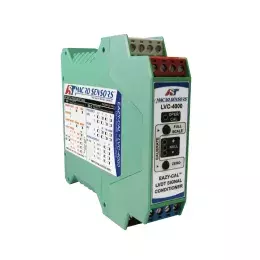
LVC-4000: TE Macro Sensors AC LVDT signal conditioner with adjustable excitation and multiple output options.
SC-200: Alliance Sensors Group single-channel LVDT signal conditioner in compact DIN-rail mount package.
S2A: Alliance Sensors Group signal conditioner with ratiometric capability for constant sum-of-secondaries LVDTs.
About Harold G. Schaevitz Industries
Harold G. Schaevitz Industries (HGSI) is a factory-authorized TE Connectivity Macro Sensors distributor providing heavy-duty position sensing solutions for industrial applications. Contact our team for pricing, technical support, or assistance with sensor selection for your mill-type application requirements.