
OVERVIEW
HGSI is a factory authorized TE Connectivity Macro Sensors distributor.
Have Pricing or Technical questions? Contact us today.
Complete the contact form, call us at 248-636-1515, or email us at sales@hgsind.com
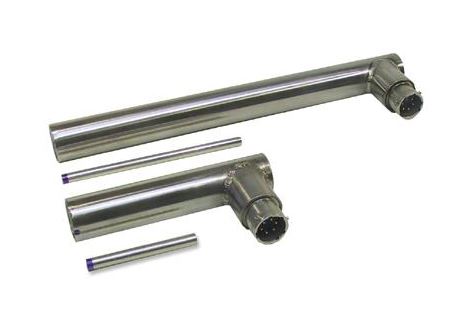
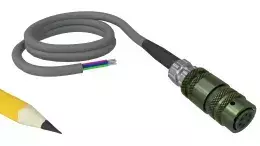
The TE Connectivity Macro Sensors’ HSER 750 Series of 3/4 inch (19 mm) diameter DC-operated LVDTs are designed for a wide range of position measurement applications. These are rugged hermetically sealed sensors, constructed entirely of stainless steel, and intended for general industrial use. The coil windings are sealed against hostile environments to IEC standard IP-68 and electrical termination is through a sealed radial connector. The radial connector offers two important benefits. First, it results in a through-bore design, which permits access to either or both ends of the LVDT’s core for better mechanical support and core guidance, and easier cleanout in dusty or dirty locations. The second advantage of the radial connector is shorter installed length compared to units of the same range with axial connectors. The mating connector plug is supplied with the unit.
HSER 750 Series sensors use built-in electronics to provide the desirable features of an AC-LVDT, such as frictionless operation and dynamic response, with the added convenience and simplicity of DC input and precalibrated DC output. They are designed to operate in conjunction with PLCs, digital indicators, A/D converters, computer-based data processors and QC data collection systems.
Available in ranges of 0.100 inch (2.5 mm) to 20.00 inches (500 mm), the HSER 750 Series sensors feature the high resolution, excellent repeatability, and low hysteresis associated with LVDT technology. Their exceptional reliability is a result of manufacturing processes and assembly techniques developed and optimized by Macro Sensors over many years of manufacturing LVDT sensors. The standard maximum linearity error for any of these sensors is ±0.25% of full scale output using a statistically best-fit straight line derived by the least squares method. A linearity error of less than or equal to ±0.10% of full scale output is available as an option.
Part Numbers
HSER-750-100
HSER-750-250
HSER-750-500
HSER-750-1000
HSER-750-2000
HSER-750-4000
HSER-750-6000
HSER-750-8000
HSER-750-10000
HSER-750-15000
HSER-750-20000
Options:
TECHNICAL SPECIFICATIONS
DOCUMENTS & DOWNLOADS
VIDEOS
No Result Found
PRODUCT NUMBERS
Product Description
The HSER-750-TE DC-LVDT from H.G. Schaevitz LLC (HGSI) delivers superior position measurement precision in a hermetically-sealed package designed for the most demanding industrial environments. This advanced Linear Variable Differential Transformer combines critical performance features: full stainless steel construction, complete environmental isolation to IP-68 standards, and a radial connector design for through-bore access. Available in measurement ranges from 0.100 inch (2.5 mm) to 20.00 inches (500 mm), the HSER-750-TE provides reliable position feedback in harsh conditions where conventional sensors would quickly fail.
Unlike traditional AC-LVDTs that require external signal conditioning equipment, the HSER-750-TE operates as a true DC-in/DC-out precalibrated position sensor. The built-in electronics module contains all necessary signal conditioning circuitry, including oscillator, demodulator, and output amplifier stages, delivering industry-standard voltage or current loop outputs directly compatible with PLCs, data acquisition systems, and digital monitoring or control devices.
Key Features
Hermetically sealed stainless steel construction for maximum environmental protection in corrosive atmospheres, submersion applications, and pressure variations
Through-bore radial connector design enabling core access from either end for superior mechanical support, improved guidance, and simplified maintenance
Built-in signal conditioning electronics eliminating external signal conditioner requirements while providing precalibrated DC voltage (0-5V, 0-10V) or 4-20 mA current loop outputs
Extensive measurement range options from 0.100 inch to 20.00 inches with linearity error of ±0.25% FSO standard (±0.10% available)
Frictionless, non-contact operation with no physical contact between core and coil assembly, ensuring exceptional long-term reliability with nothing to wear out
Understanding DC-LVDT Technology
Why DC-LVDTs Simplify System Integration
LVDTs with built-in electronics are designated DC-LVDTs because they operate as DC-in/DC-out precalibrated position sensors. While they incorporate the same electromagnetic operating principles as AC-LVDTs, the integrated electronics module handles all signal conditioning functions internally. This eliminates the need for external oscillators, demodulators, and signal processing equipment that traditional AC-LVDTs require.
Modern DC-LVDTs like the HSER-750-TE utilize dedicated semiconductor chips combined with surface-mounted passive components to create electronic modules compact enough to fit within standard industrial LVDT housings. These internal modules provide the same functionality as external signal conditioners but are optimized specifically for the individual sensor, eliminating the need for multiple excitation frequencies, adjustable system gains, or complex output configuration.
The result is a precalibrated measuring instrument that connects directly to downstream equipment. Engineers specify the desired output configuration during ordering, and the sensor arrives ready for immediate installation without calibration procedures or signal conditioning setup.
Output Signal Options
The HSER-750-TE provides industry-standard analog outputs optimized for different application requirements:
DC Voltage Outputs: Available in 0-5V DC, 0-10V DC, or bipolar ±10V DC configurations. Voltage outputs are ideal for shorter cable runs (typically under 5 meters) and provide direct compatibility with most PLC analog input modules and data acquisition systems. For microprocessor-based systems, live-zero outputs (0.5-4.5V DC or 0.5-9.5V DC) provide built-in fault detection capability, where voltage in the zero-offset range indicates sensor or wiring problems.
4-20 mA Current Loop Output: The preferred choice for long cable runs and electrically noisy environments. Current loop transmission offers several significant advantages: loop current does not vary with field wiring length as long as compliance voltage is maintained; the low impedance loop is not particularly susceptible to EMI or electrical noise; the 4 mA live-zero provides self-diagnostic capability if there is a break or bad connection in the loop; and the low maximum current (20 mA) allows straightforward implementation of intrinsically safe barriers for hazardous location installations.
Measurement Performance Characteristics
Repeatability: The Foundation of Measurement Quality
The single most important factor in any position measuring system is repeatability. Repeatability measures the variation between outputs for repeated trials of an identical measurand input under constant environmental conditions. Unlike linearity errors that can be calibrated out through lookup tables or polynomial correction algorithms, repeatability represents a fundamental limitation that cannot be compensated through calibration. In effect, repeatability defines the minimum uncertainty in the position measurement process.
The HSER-750-TE's LVDT operating principle delivers outstanding repeatability because there is no physical contact between the movable core and the coil assembly. With no sliding contacts to wear, no friction-inducing surfaces, and no mechanical elements that degrade over time, the sensor maintains consistent performance throughout its operational life. This frictionless operation is why well-designed LVDTs are specified for demanding measurement applications where long-term reliability is essential.
Linearity and Calibration Considerations
A high degree of linearity is critical for position measuring systems because it determines how readily the system can be calibrated and how much uncertainty exists about any particular output value. The HSER-750-TE provides standard linearity error of ±0.25% of full scale output, with optional ±0.10% linearity available for critical measurement applications.
These linearity specifications are referenced to the least-squares best-fit straight line, which statistical theory and practical experience both favor as the most meaningful reference. The least-squares method finds the line that comes as close as possible to each data point by minimizing the sum of squared deviations, providing a truly best-fit curve that accurately represents sensor performance.
For applications requiring the highest possible accuracy, the HSER-750-TE's precalibrated output can serve as input to downstream PLCs or computers where calibration data at selected points within the sensing range is stored in a lookup table. Using interpolation algorithms between calibration points typically results in at least an order of magnitude improvement in measurement accuracy compared to the sensor's baseline specifications.
Resolution and Signal-to-Noise Considerations
Resolution represents the smallest change in position input that produces a measurable change in electrical output. While this seems straightforward, effective resolution is significantly impacted by factors external to the sensor itself, particularly the signal-to-noise ratio of the system's analog output.
The HSER-750-TE's built-in electronics are designed to maximize effective resolution by minimizing output noise and ripple. For optimal system performance, it is important to use DC power supplies with low noise and ripple characteristics; otherwise the system output will contain noise that raises the effective noise floor and masks small position changes. Linear power supplies generally provide better results than switching supplies for position measurement applications where resolution is critical.
The 0-10V DC output option provides superior signal-to-noise ratio compared to lower voltage ranges, as the larger output signal level improves the ratio relative to fixed noise sources. For applications connecting to microprocessor A/D converters, ensure the input resistance is high enough (50 kΩ recommended, 10 kΩ minimum) to avoid loading down the sensor's voltage output.
Hermetic Environmental Protection
The HSER-750-TE features true hermetic sealing to IEC standard IP-68 that provides complete protection against environmental challenges in extreme industrial applications. Unlike standard environmentally-protected sensors with limited sealing, the all-stainless steel construction with sealed coil windings fully isolates internal components from external environments, enabling reliable operation in conditions that would compromise even ruggedized conventional sensors.
DC-LVDTs have two primary design considerations beyond their AC counterparts: the upper temperature rating of the electronics (typically 70°C to 125°C for solid state components) and the method of sealing the sensor from water, weather, and corrosive atmospheres. The HSER-750-TE addresses both through its hermetically sealed stainless steel housing and fully potted internal electronic module.
This construction makes the HSER-750-TE particularly valuable in applications involving excessive moisture, complete submersion, pressure variations, or corrosive atmospheres where measurement integrity must be maintained despite challenging environmental conditions.
Radial Connector and Through-Bore Design
The HSER-750-TE's radial connector design provides significant operational advantages not available with conventional axial connector models. The through-bore configuration permits access to either or both ends of the LVDT's core, enabling superior mechanical support, improved core guidance, and simplified maintenance in contaminated environments.
A significant advantage of LVDT technology is that there is no physical contact needed between the core and the coil assembly, and there is no requirement to maintain precise concentricity between these elements. The sensor responds only to core motion along its long axis, meaning minor radial misalignment does not affect measurement accuracy. This characteristic simplifies mounting requirements and contributes to long-term reliability because there are no sliding contacts or wear surfaces.
The radial connector configuration also reduces installed length compared to equivalent axial models, providing important advantages in space-constrained installations while maintaining full measurement performance.
Application Areas
Power Generation and Industrial Process Control
The HSER-750-TE excels in power generation applications where precise position feedback is essential for steam turbine control systems, valve positioning, and actuator feedback. The 4-20 mA current loop output is particularly valuable in these installations because loop current does not diminish over the long field wiring runs typical of power plant instrumentation, and the low impedance signal transmission is resistant to the electrical noise present in industrial environments.
For process control applications, the current loop output permits insertion of local readout devices in series with the loop within the constraints of the compliance voltage. The 4 mA live-zero provides immediate indication of loop faults, enabling rapid identification of wiring problems or sensor failures that could otherwise compromise process control reliability.
Marine and Offshore Systems
For marine applications requiring reliable position feedback with superior environmental protection, the HSER-750-TE provides essential features for successful implementation. The hermetic construction prevents damage from salt water, moisture, or marine atmospheres while DC operation simplifies integration with shipboard control systems.
The stainless steel construction resists corrosion in marine environments while the sealed electronics ensure consistent measurement performance where conventional sensors would rapidly deteriorate. Similar applications in offshore platforms, subsea equipment, and shipboard machinery benefit from the same combination of environmental robustness and measurement precision.
Dimensional Measurement and Quality Control
Spring-loaded DC-LVDT sensors are frequently utilized in dimensional measuring systems for dedicated shop-floor quality control and quantitative data gathering applications. The HSER-750-TE's exceptional repeatability and low hysteresis ensure consistent measurement results essential for statistical process control and quality assurance programs.
The frictionless operation eliminates the wear-related drift that compromises measurement consistency in contact-type sensors, while the precalibrated DC output simplifies integration with data acquisition systems and automated inspection equipment.
Installation and System Integration
DC Voltage Output Connections
For DC voltage output configurations, use shielded cable to minimize pickup of EMI and radiated noise, particularly for cable runs approaching the 5-meter practical limit. Ensure the receiving device's input resistance is sufficient to avoid loading down the sensor output (50 kΩ recommended). The output cable shield should be grounded at one end only to prevent ground loop formation.
Current Loop Output Connections
The 4-20 mA current loop configuration supports extended cable runs because current does not diminish with field wiring length as long as the loop supply voltage exceeds the sum of all voltage drops in the circuit (the minimum compliance voltage). The loop load resistor value depends on the input signal voltage the receiving system requires: a 250 Ω resistor develops 1-5V DC across the 4-20 mA range, while a 500 Ω resistor develops 2-10V DC.
Check the receiving device specifications to determine if a loop load resistor is already built into the input terminal connections. The loop load resistor power rating should be at least 2 Watts to ensure that heating from current flow does not change the resistor value and affect measurement accuracy.